Mini quad motors play a crucial role in FPV drones, directly impacting their performance, efficiency, and longevity. If you’re searching for the best mini quad motors for your FPV drone, this guide will help you understand your options.
This guide is designed for FPV drone enthusiasts, racers, and hobbyists seeking to select the best mini quad motors tailored to their specific needs. Selecting the right motor is crucial for achieving the desired balance of speed, efficiency, and durability in your mini quad.
Mini quad motors are engineered for small frames under 250g, reducing overall drone weight. Brushless motors are usually the go-to choice for mini quads because they deliver strong power, better efficiency, and greater reliability.
Knowing how these motors are built and what design features matter can help you get the most out of your mini quad. The right motor depends on your flying style, what performance you want, and your budget. It’s also important to consider the total weight and maintenance costs, not just the initial price. The market offers a wide range of motors, each balancing cost and performance differently.
Types of Motors
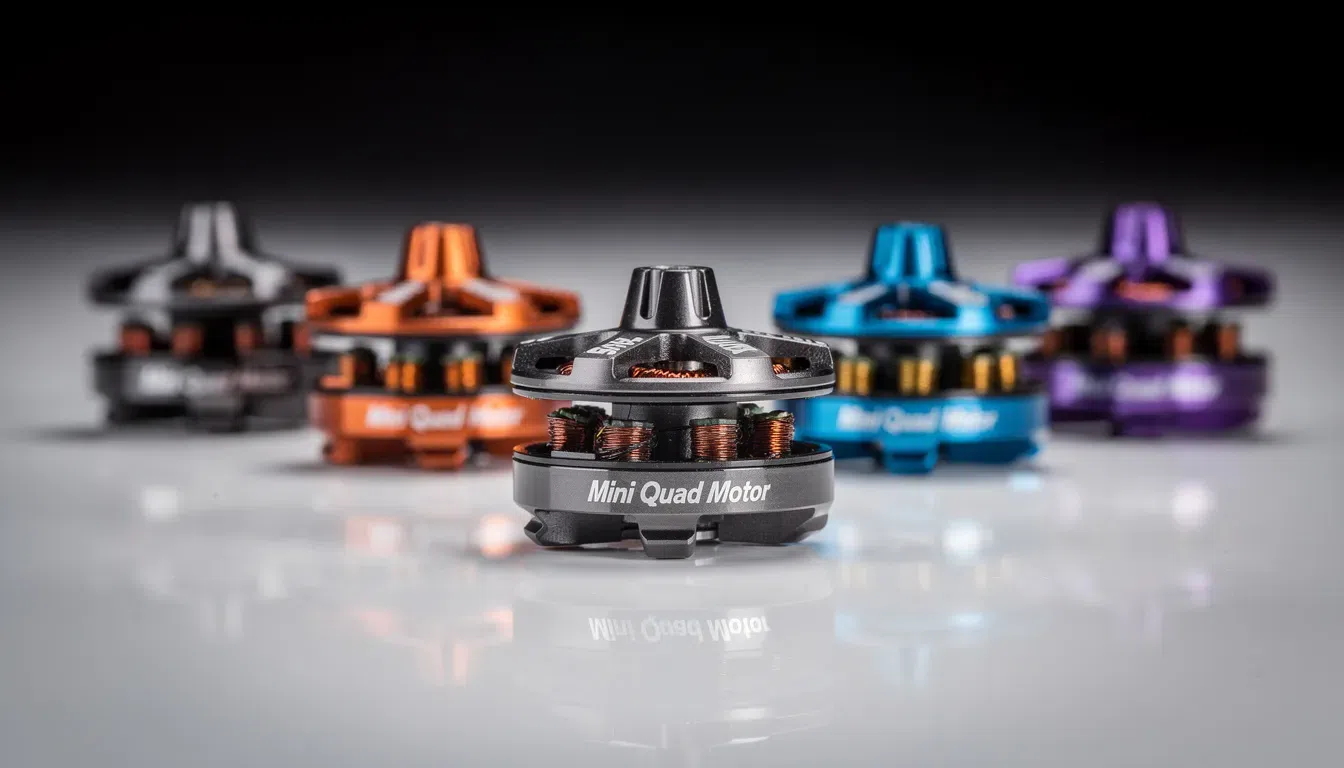
- Brushless motors outperform brushed motors in terms of power, reliability, and efficiency. Brushed motors tend to be found in cheaper toy drones because they cost less upfront.
- While brushed motors are cheaper initially, they wear out faster and need frequent replacements, which adds up over time. Brushless motors last longer and usually save you time and money in the long run.
- Efficient motors with low KV ratings are great for cruising and long-distance flights. High KV motors, on the other hand, give you more power and speed for racing or freestyle flying.
- Micro motors are built for ultra-light drones under 250g, packing a punch despite their small size.
When comparing popular budget mini quad motors, the following table summarizes key options:
| Model | Price | Key Features |
|---|---|---|
| T-Motor Velox V2207 V2/V3 | $14.90 | Solid performance, budget-friendly |
| EMAX ECO II 2207 | $16.00 | Highly regarded, best budget FPV motor |
| iFlight Xing2 2207 | $21.00 | Impressive torque, responsive |
| EMAX ECO II 2004 | $– | Reliable, budget-friendly |
These motors give good value for those who want quality without breaking the bank.
Understanding Motor Size and Configuration
Mini quad motors are identified by a four-digit code indicating stator dimensions, where the first two digits are width, and the last two are height. Motor size is usually shown as a four-digit number: the first two digits indicate the stator diameter, and the last two show the stator height. This coding is standard in the RC world.
Understanding these dimensions helps you gauge key performance aspects like torque, speed, and responsiveness. Bigger stator diameters can boost torque but add weight, which might reduce responsiveness. This makes larger diameters less ideal for racing or freestyle drones. The diameter also affects how well the motor fits with your drone’s other parts.
Motor configuration, including the number of poles and magnets, influences power output, efficiency, and how durable the motor is. The most efficient mini quad motors strike a balance between power, efficiency, and responsiveness.
Motor Performance Factors
The performance of mini quad motors is characterized by kV rating (RPM per volt) and current draw, which are crucial for matching with appropriate propellers and Electronics Speed Controllers (ESCs). Mini quad motors need to be matched with specific propeller sizes and ESCs that can handle their power draw to ensure balanced performance.
Thrust and Torque
Thrust, torque, and efficiency are the core performance metrics for mini quad motors. These factors shape how your drone flies and how long your motors last. You can estimate the needed thrust and efficiency by looking at the motor’s KV rating (RPM per volt) and current draw. Matching these specs with the right propeller and ESC is key.
KV Rating
Running motors at full throttle heats them up, which can shorten their lifespan. High KV motors deliver more power but use more energy, which reduces flight time and increases heat. Low KV motors fly more conservatively and efficiently, but might not have the punch for aggressive flying.
Propeller Matching
High torque motors respond quickly to throttle changes, allowing faster RPM shifts and smoother flight with less prop wash. The best FPV motors balance power, efficiency, and responsiveness to suit different flying styles.
Advanced Motor Considerations

Motor Windings and Materials
- Motor windings, materials, and cooling systems all affect how well a motor performs and lasts. For example, single-stranded windings handle high current better, making them ideal for racing and freestyle.
- Using high-quality materials like silver-plated copper wires can boost efficiency and reduce heat buildup. The number of copper windings on each stator pole determines how much current the motor can safely draw, which impacts KV and torque.
Cooling and Air Gap
- When you put a propeller on, it adds load to the motor, causing RPM to drop and current draw and heat to rise due to air resistance.
- Cooling features like optimized air gaps and stator laminations improve motor performance and durability. A smaller air gap between magnets and stator increases power and torque.
- Some of the most advanced mini quad motors use designs like Unibell and specialized bottom plates to enhance durability and performance.
Motor Components and Features
- Bearings, shafts, and mounts all influence motor efficiency, smoothness, and lifespan.
- High-quality bearings, whether ceramic or steel, reduce vibration and wear. Ceramic bearings are smoother but can be more fragile in crashes.
- Durable shafts and mounts made from aluminum or steel keep the propeller secure and help prevent damage during hard landings.
- Features like PoPo technology and solder tabs make maintenance easier and improve overall motor performance. You can reverse motor rotation by swapping wires or through software settings, which is important for proper propeller setup.
CW and CCW Motors
CW (clockwise) and CCW (counterclockwise) motors are designed to spin in specific directions, which is essential for balanced flight.
Racing drones usually need high KV, lightweight motors for quick response, while freestyle pilots often prefer motors that offer a good balance of power and smooth control.
CW motors tend to provide more power, suiting aggressive flying styles, whereas CCW motors are often more efficient, ideal for cruising and long-range flights.
Knowing the difference helps you pick the right motor setup for your flying needs.
Motor Windings and Materials
Quality of Windings
The quality of motor windings and materials plays a big role in performance and durability. Motors don’t have strict voltage limits since they don’t contain electronics inside, but heat and current still affect how well they work.
Silver-plated copper windings improve conductivity and reduce heat, boosting efficiency.
Magnet Materials
Rare earth magnets help motors deliver better power-to-weight ratios.
The most efficient mini quad motors combine optimized windings and materials to balance power, efficiency, and responsiveness. Remember, brushless motors need an ESC to operate, unlike brushed motors.
Motor Mounting and Connection
- Secure motor mounting is essential for stable flight and durability. M3 screws are commonly used for mounting mini quad motors.
- Efficient connections to ESCs and batteries reduce power loss and improve performance.
- The best mini quad motors feature simple, reliable mounting and connection systems that make installation and maintenance straightforward.
Motor Durability and Maintenance
- Durable motors built with quality materials and thoughtful design tend to last longer and require less upkeep.
- Regular cleaning and inspection help keep motors running smoothly and extend their lifespan.
- The most efficient mini quad motors are designed for easy maintenance, making them a practical choice for FPV pilots.
Unibell and Bottom Design
- The Unibell design improves motor durability by reducing the risk of damage, which is especially valuable in racing and freestyle.
- Bottom plate designs made from aluminum or steel provide secure mounting and protect the motor.
- Motors with optimized Unibell and bottom designs offer a solid balance of power, efficiency, and durability.
Stator Laminations and Technology
Stator laminations are thin metal layers stacked in the motor stator that affect efficiency. Thinner laminations reduce Eddy Current losses, which produce heat and waste energy. By minimizing these losses, motors run cooler and more efficiently, delivering better power and longer flight times.
Recent advances use ultra-thin laminations and special alloys to push performance further. When picking motors, look for those with modern lamination technology to improve your drone’s efficiency and flight experience.
FPV Drones Motor Compatibility
Motor compatibility impacts how well your drone performs and how efficient it is. When planning your build, consider the total weight of all components:
- Frame
- Flight controller
- ESC
- Motors
- Propellers
- Receiver
- Video transmitter
- Antenna
- Battery
- Any cameras
The best motors are designed to work seamlessly with specific frames, prop sizes, and battery types to optimize performance.
Understanding compatibility ensures you get the most out of your FPV drone.
Mini Quad Motor Selection
Choosing the right mini quad motor depends on your flying style, payload, and frame type.
Matching motor KV to battery voltage and prop size is key to maximizing performance and efficiency.
The most efficient motors offer a good mix of power, efficiency, and responsiveness tailored to your needs.
If you’re unsure which motor to pick, start by thinking about how you fly and what you want your drone to do.
Micro Motors in Drones
Micro motors are made for the smallest drones, like sub-250g micro quads, and whoop-style builds. They feature compact mounting patterns and lightweight construction to keep weight down.
Despite their size, quality micro motors deliver impressive power and responsiveness, whether flying indoors or outdoors.
Low KV micro motors help with longer flight times and smooth handling, while higher KV options provide more speed and agility for racing or acro flying.
Reading pilot reviews and choosing reputable brands like Retek Motion can help you find micro motors that balance speed, durability, and efficiency.
Estimating Drone Weight and Frame Size
Calculating your drone’s total weight and picking the right frame size are crucial steps before selecting motors.
When considering your FPV drone’s total weight, make sure to account for all components: frame, FC, ESC, motors, propellers, RX, VTX, antenna, ESCs, LiPo battery, and GoPro.
Follow these steps:
- List all components you plan to use.
- Weigh each component or use the manufacturer’s specifications.
- Add up the total weight.
- Choose a frame size that fits your build and desired propeller size.
Larger frames can fit bigger propellers, which require more powerful motors to spin efficiently and provide enough lift. For example, a 5-inch frame with a 4S battery needs stronger motors than a 3-inch frame with a 3S battery.
Using online calculators or advice from experienced pilots can help match your frame and weight to the best motor specs.
Determining Thrust Requirements
Your drone’s total thrust should be at least twice its weight for stable flight. For instance, a 1kg drone needs motors that collectively produce at least 2kg of thrust.
This ensures enough power for takeoff, maneuvering, and handling extra loads.
Racing drones often aim for a thrust-to-weight ratio between 10:1 and 14:1 for quick acceleration and agility. Freestyle and general-purpose drones typically need a minimum 5:1 ratio for smooth control.
Each motor should provide about a quarter of the total thrust.
Using thrust calculators or consulting experienced pilots can help you find the right motor and prop combo.
Accurately determining thrust ensures your mini quad is both powerful and efficient.
Brushless Motor Maintenance
Keeping brushless motors clean and inspecting them regularly helps maintain performance and extend their lifespan.
In my experience, simple maintenance routines can prevent many common motor issues and keep your drone flying smoothly.
The best brushless motors are designed to be easy to maintain, which is a big plus for FPV pilots who want reliable gear.


